Finding faster quantum algorithms with agents and formal verification
deepmind.google·3d ago
TL;DR
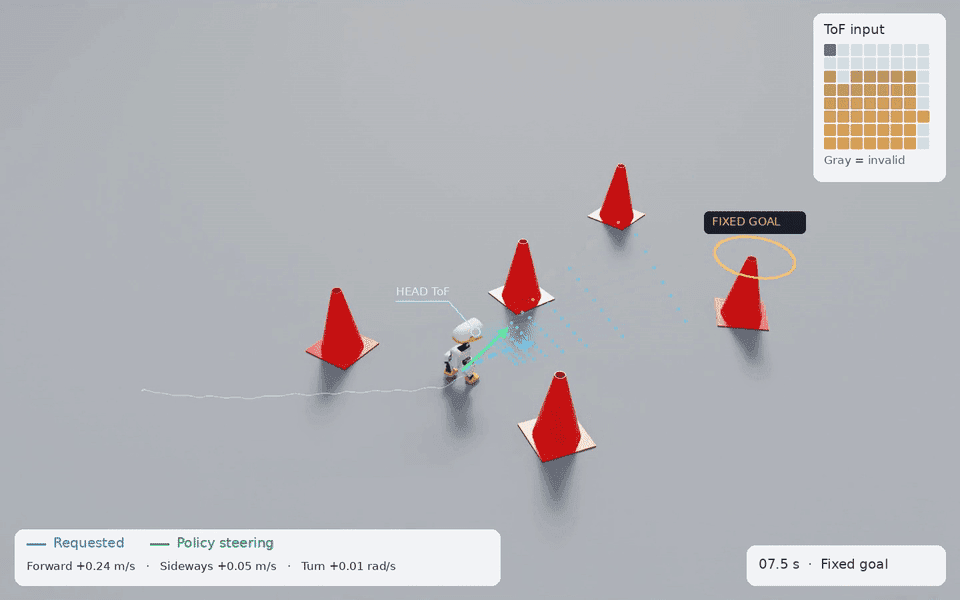
Microduck now features local obstacle avoidance while maintaining its walking policy, achieved through a separate avoidance controller trained using NVIDIA Isaac Lab and Newton. This workflow enables real-robot deployment after simulation training and evaluation.
✦ Why It Matters
Implement local obstacle avoidance in your robotic projects using this Sim2Real workflow today.
Key Takeaways
Full Summary
Microduck, a robotic platform, has been enhanced with a local obstacle avoidance capability while keeping its walking policy intact. The workflow utilizes NVIDIA Isaac Lab, an open-source framework for training robotic policies, and Newton, which simulates physics and sensor data.
A separate avoidance controller is trained using time-of-flight (ToF) sensing, allowing the robot to navigate around obstacles based on gamepad inputs. During training, the robot operates in a simulated environment with varied obstacle layouts, receiving rewards for safe navigation and penalizing risky behaviors.
The training process involved 16,384 parallel environments over 1,500 iterations, demonstrating the scalability of the approach. This development allows for more sophisticated robotic behaviors and can be applied to various tasks beyond simple navigation.
Related