EmbeddingGemma 2: an open, lightweight multimodal embedding model
deepmind.google·6d ago
TL;DR
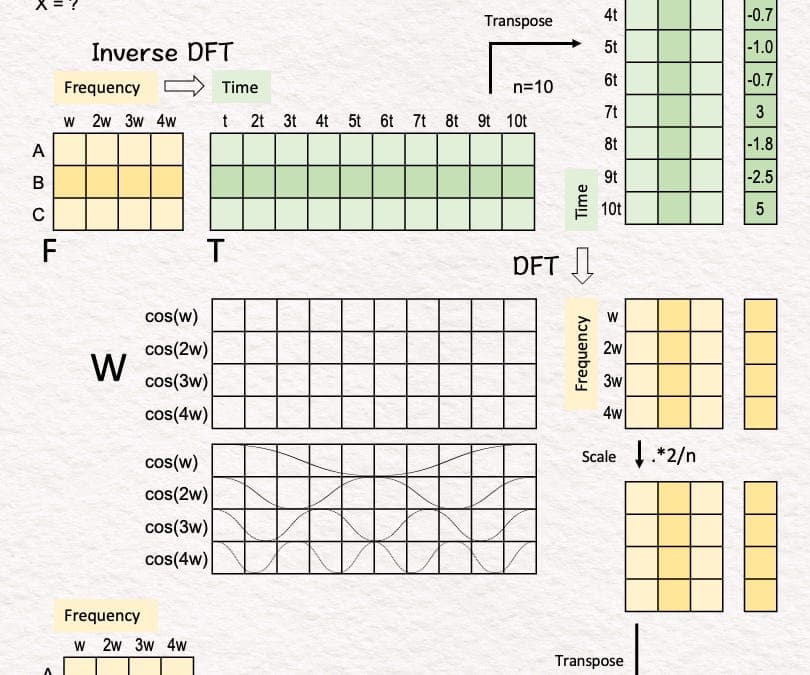
The Discrete Fourier Transform (DFT) can be understood as a series of matrix multiplications, making it accessible for manual calculation. This insight reveals parallels with deep neural networks, which also rely on matrix operations to analyze signals.
✦ Why It Matters
Explore manual DFT calculations to deepen your understanding of signal processing fundamentals today.
Key Takeaways
How It Works
The DFT operates by transforming a time-domain signal into its frequency components through a series of matrix multiplications. Each signal is represented as a weighted sum of cosine waves, and the transformation reveals the underlying frequencies present in the signal.
By constructing a frequency matrix from the coefficients of these signals, the DFT can be computed step-by-step, demonstrating its mathematical foundation.
Related