EmbeddingGemma 2: an open, lightweight multimodal embedding model
deepmind.google·6d ago
TL;DR
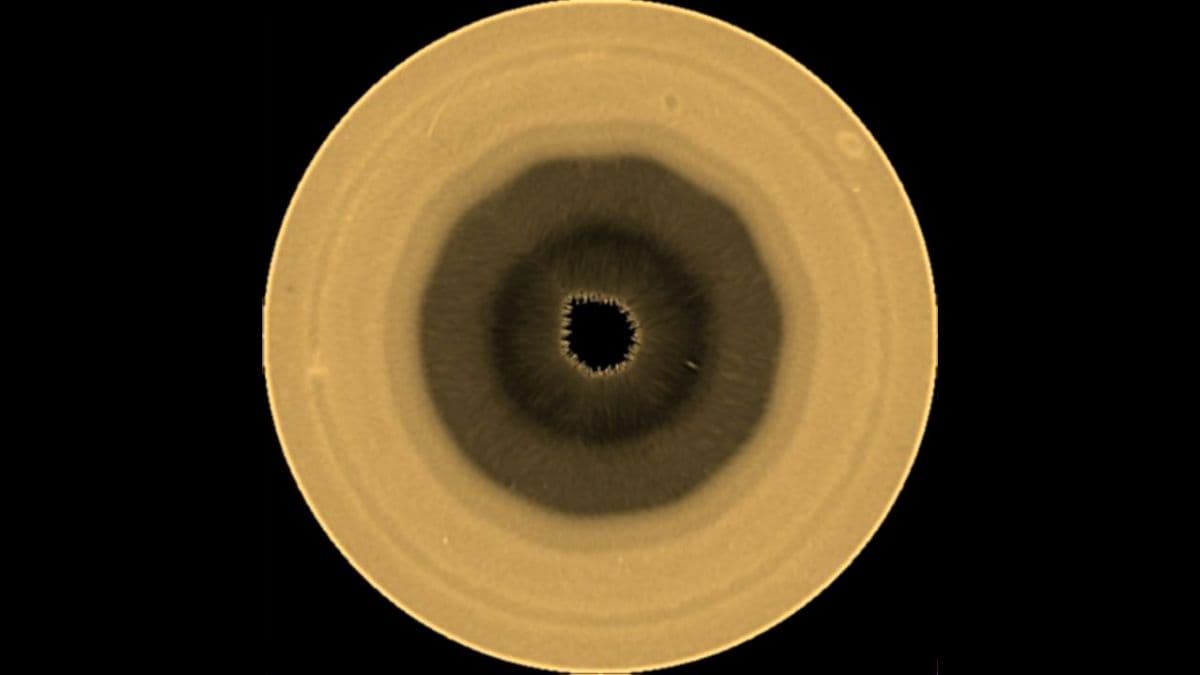
Astronomers have discovered a ten-sided atmospheric structure in Saturn's south pole, suggesting that polygonal formations are common in its atmosphere. This finding challenges the uniqueness of the well-known hexagon at the north pole.
✦ Why It Matters
Consider exploring atmospheric dynamics in gas giants to inform your own research or projects.
Key Takeaways
Full Summary
For decades, Saturn's north pole has been known for its striking hexagonal atmospheric wave, first observed by Voyager probes in the early 1980s. Recently, a team led by Agustín Sánchez-Lavega identified a new ten-sided structure, or decagon, around Saturn's south pole, confirming its existence through high-quality images from the Hubble Space Telescope.
The decagon is centered at 60 degrees south and is associated with a powerful eastward jet stream, moving at about 10 kilometers per hour, while the jet itself travels at 420 kilometers per hour. Unlike the stable hexagon, which has persisted for over 44 years, the decagon's formation is more recent, raising questions about its stability and the factors influencing its shape.
The discovery suggests that Saturn's atmospheric conditions favor the formation of polygonal structures, prompting further investigation into the dynamics at play.
Related